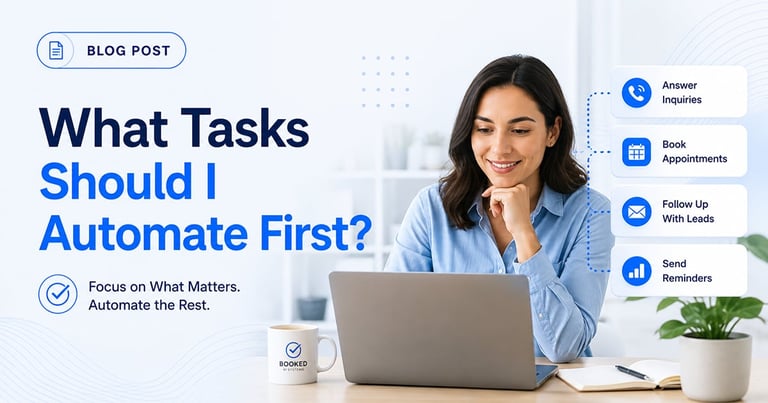
A practical guide for small service-based businesses ready to take the first step toward smarter operations.
Written by Christopher Pike, founder of Booked AI Systems.
Get automation tips in your inbox
Join 2,400+ business owners. No spam, unsubscribe anytime.
Business owners often know they are spending too much time answering the same questions, following up with leads, scheduling appointments, and managing routine customer interactions. They can see that automation would help, but the project feels too large or complicated.
My opinion is that automation should not begin with a complete overhaul of the business. It should begin with one practical problem that affects customers, leads, or bookings every day.
The first tasks to automate are usually the ones that are repetitive, time-sensitive, and directly connected to revenue.
A small service business should normally automate customer-facing tasks before internal administrative work.
Internal automation can certainly save time. However, automating how quickly a business responds to potential customers can have a more immediate effect.
When someone visits a website or calls a business, they are often trying to answer a few basic questions:
If the customer cannot find those answers quickly, they may leave and contact another business.
This is why I believe the first automation should usually focus on answering questions, collecting lead information, qualifying potential customers, and helping people take the next step.
Most small businesses answer the same questions repeatedly.
These questions may arrive through phone calls, contact forms, social media messages, website chat, or email. Individually, each question may only take a few minutes to answer. Over a week or a month, however, they consume a significant amount of time.
AI automation can answer common questions about:
This does not mean every customer should receive a generic or robotic response. The purpose is to handle the straightforward questions instantly so the business owner can focus on situations that require personal knowledge or judgment.
A smart website can become much more than an online brochure. It can engage with customers 24 hours a day, seven days a week, even when the owner is working, driving, meeting with another customer, or finished for the day.
Once a customer has received the information they need, the next step should be easy.
Too many businesses still rely on a long chain of messages to schedule an appointment.
The customer asks about availability. The business responds later. The customer suggests a time. That time is no longer available. Another message is sent, and the process continues.
Every additional step creates an opportunity for the customer to lose interest or contact someone else.

Connecting appointment booking directly to the business calendar removes much of this friction. Customers can see appropriate availability, choose a time, and book the next step without waiting for the owner to respond manually.
This can be especially useful for businesses that offer:
The owner remains in control of the calendar, available hours, appointment types, and booking rules. The automation simply handles the repetitive coordination.
Not every enquiry is ready for the same next step.
Some customers need a quick answer. Others are ready to book. Some may be outside the service area, looking for a service the company does not provide, or missing information the business needs before following up.
AI automation can qualify leads in real time by collecting details such as:
This information helps the business respond more effectively.
Instead of returning a missed call without knowing what the customer needs, the owner can receive a useful summary. Instead of exchanging several messages to collect basic details, the information is already available.
The goal is not to interrogate the customer or create a complicated questionnaire. The goal is to collect enough information to determine the right next step.
Automation works best when it handles predictable interactions and recognizes when a human response is required.
A customer may have a complex question, an unusual request, a sensitive concern, or a situation that does not fit the standard process. In those cases, the automation should not attempt to force the conversation into a fixed answer.
It should route the call, notify the business owner, collect the information needed for follow-up, or book a personal conversation.
This is an important distinction.
Good automation does not remove the business owner from the customer relationship. It prevents the owner from having to manage every routine interaction personally.
The business still provides the expertise, judgment, service, and human connection. Automation supports that work by handling the repetitive steps around it.
One of the biggest mistakes I see is simply not taking the first step.
Business owners may believe they need to automate everything at once. They start thinking about websites, phone systems, customer relationship management software, email campaigns, social media, calendars, quoting systems, and follow-up sequences.
The project quickly becomes overwhelming, so nothing changes.

A better approach is to choose one clear problem.
For example:
Choose the issue that happens most often or has the greatest effect on new business. Automate that first. Once it is working properly, move to the next problem.
The first automation does not need to be perfect. It needs to be useful.
Ask four questions to determine whether a task is right for automation:
Tasks that repeat daily or weekly are prime candidates.
Quick responses win business. Automation is instant.
If there's a predictable flow, it can be automated.
Negotiations and complaints need a person.
Tasks involving negotiation, complaints, or complex decisions should normally involve a person.
For many small service-based businesses, a smart website is one of the most practical places to begin.
It can provide customers with immediate answers, explain services, collect lead details, qualify enquiries, and book appointments directly into the business calendar.
A simple first version might do the following:
This creates a clear customer journey without requiring the owner to be available for every first interaction.
It also gives the business something measurable. The owner can track questions answered, appointments booked, leads collected, calls routed, and enquiries received outside normal business hours.
The best automation is not always the most advanced.
It is the automation that makes it easier for a customer to get information, make a decision, and take the next step.
Small businesses should avoid automating a process simply because the technology exists. Each automation should solve a real problem.
It should make the experience faster, clearer, or more convenient for the customer while reducing repetitive work for the business. When those two benefits happen together, the automation is serving a useful purpose.
Start with the point where customers are waiting, getting confused, or dropping away.
For many small businesses, that means starting with a Smart Website that can automate:
Begin with one repetitive interaction that affects customers every day. Make it work well. Measure the result. Then build from there.
About the Author
Christopher Pike is the founder of Booked AI Systems. He partners with local service businesses to build smarter websites, strengthen their SEO and AI visibility, and implement practical automation that captures leads, answers customers faster, and supports steady growth. When he's not helping business owners work smarter, he's testing the latest AI tools to find what actually delivers results — so his clients don't have to.
Start automating the tasks that matter most to your business. Our AI receptionist handles calls, books appointments, and qualifies leads — 24/7.