A practical guide for small service businesses exploring AI-powered call answering, appointment booking, and lead qualification.
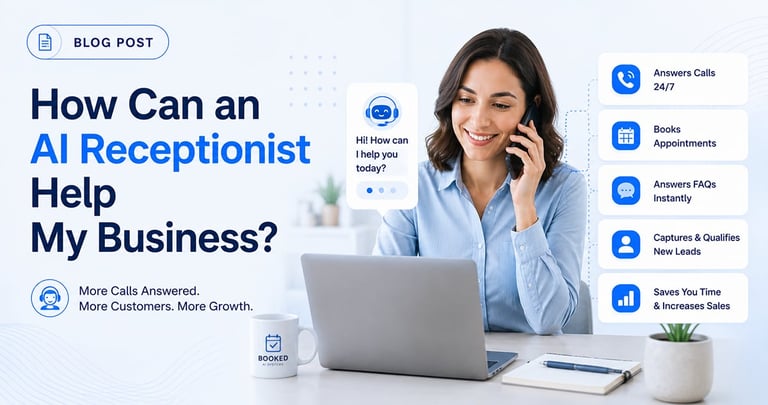
Written by Christopher Pike, founder of Booked AI Systems.
Get automation tips in your inbox
Join 2,400+ business owners. No spam, unsubscribe anytime.
The problem is that the business owner is often the person doing the work. They may be on a job site, meeting with a client, driving between appointments, or handling another customer when the phone rings.
After hours, the same problem continues. A potential customer may be ready to ask a question or book an appointment, but no one is available to answer.
An AI receptionist helps solve this problem by answering calls, responding to common questions, qualifying callers, collecting their details, and booking appointments.
The goal is not to replace the business owner or existing staff. It is to make sure customers receive a prompt response without requiring someone to manage every call personally.
A missed call can quickly become a missed customer.
Many callers do not leave voicemail. Even when they do, they may continue contacting other businesses while waiting for a response.
For a small service business, this creates a difficult choice. The owner can interrupt the work in front of them or risk losing the next opportunity.
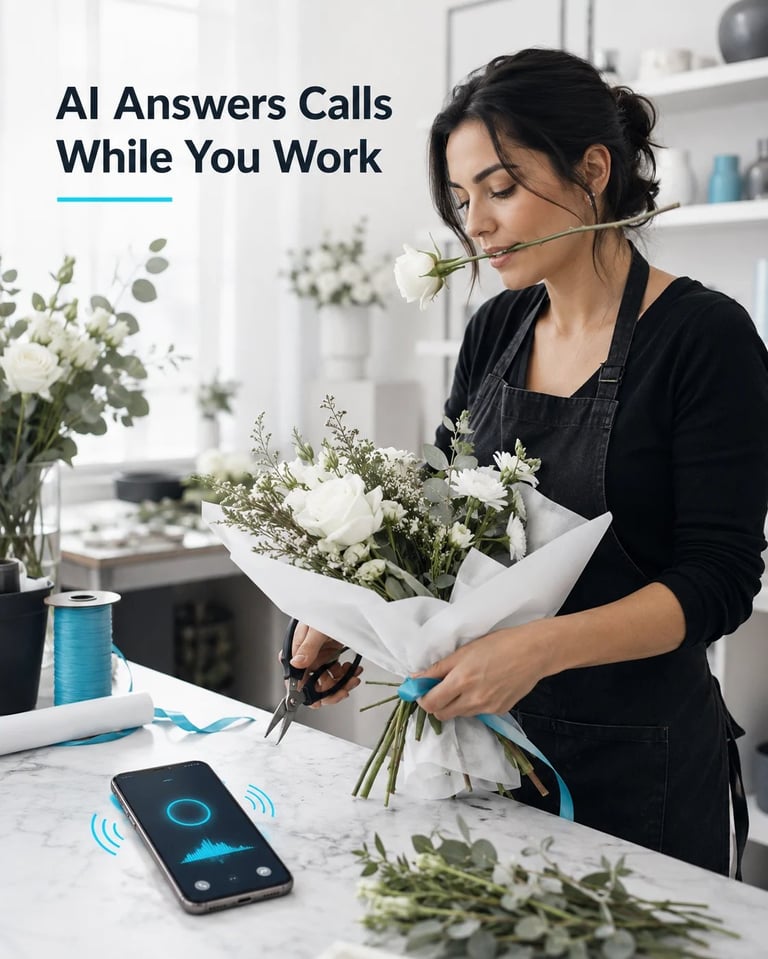
An AI receptionist can answer calls while the owner is:
The caller receives an immediate response rather than being sent directly to voicemail.
This is particularly useful for businesses where the owner is also the contractor, technician, consultant, photographer, or service provider.
Customers do not always call during normal business hours.
They may search for a service in the evening, on a weekend, or during a lunch break. In many cases, they are ready to make a decision when they call.
An AI receptionist can respond at any time. It can answer basic questions, collect the caller's information, confirm whether the business offers the service they need, and offer an available appointment.
A customer who calls after hours may be able to book an appointment before the owner starts work the next morning. This gives the business better coverage without requiring the owner or staff to remain available around the clock.
Websites with AI chat that engage customers 24/7 can provide the same immediate support to people who contact the business online.
Many calls begin with the same questions:
An AI receptionist can be trained using information specific to the business. It can explain the company's services, pricing approach, availability, service area, policies, and booking process.
For businesses where every job is different, the AI does not need to provide a final quote. It can explain starting prices or price ranges, collect the details needed, and arrange an estimate or consultation.
The AI should only provide information approved by the business. When properly set up, it gives customers useful answers without making promises the business cannot keep.
Not every caller needs the same next step.
Some customers only need an answer. Others are ready to book. Some may be outside the service area or looking for a service the company does not provide.

An AI receptionist can ask relevant questions and collect information such as:
This data flows directly into a central dashboard or CRM, meaning the owner receives more than a message saying, "Please call me back." They receive an organized, actionable summary explaining who called, what they need, and what action should happen next.
That makes follow-up faster and more productive.
One of the most useful features of an AI receptionist is appointment booking.
A customer may call to ask about a service, pricing, and availability. The AI can answer those questions, collect the customer's details, qualify the enquiry, and book an appropriate appointment directly into the business calendar.
This reduces the back-and-forth that often happens when scheduling. Without automation, the customer may leave a message, miss the return call, call back again, and exchange several possible appointment times.
With an AI receptionist, the booking can often be completed during the first conversation.
The business remains in control of:
The AI handles the coordination while the business controls the rules.
Not every call should be handled entirely by automation.
Some enquiries are complex, urgent, sensitive, or outside the normal process. In those situations, the AI receptionist should recognize that a personal response is needed.
It can transfer the call when someone is available. When an immediate transfer is not possible, it can collect the caller's information and arrange the next step.
A well-designed AI receptionist should know when to:
Good automation does not force every caller through the same script. It guides each person toward the most appropriate next step.
Consider a customer calling a local service business after hours.
The customer asks whether the company provides a particular service, how pricing works, and whether an appointment is available later in the week.
The AI receptionist answers the service question, explains the approved pricing information, and checks the calendar.
It then collects the customer's name, contact information, location, and a few details about the job.
After confirming that the enquiry is a suitable fit, it offers an available appointment. The customer selects a time, and the booking is added directly to the calendar.
The business owner receives the appointment and the information collected during the call. Without the AI receptionist, that same customer may have reached voicemail and contacted another company.
Some business owners assume an AI receptionist will sound robotic or frustrate callers.
That concern often comes from experiences with older automated phone systems that required callers to press buttons, listen to long menus, or repeat themselves.
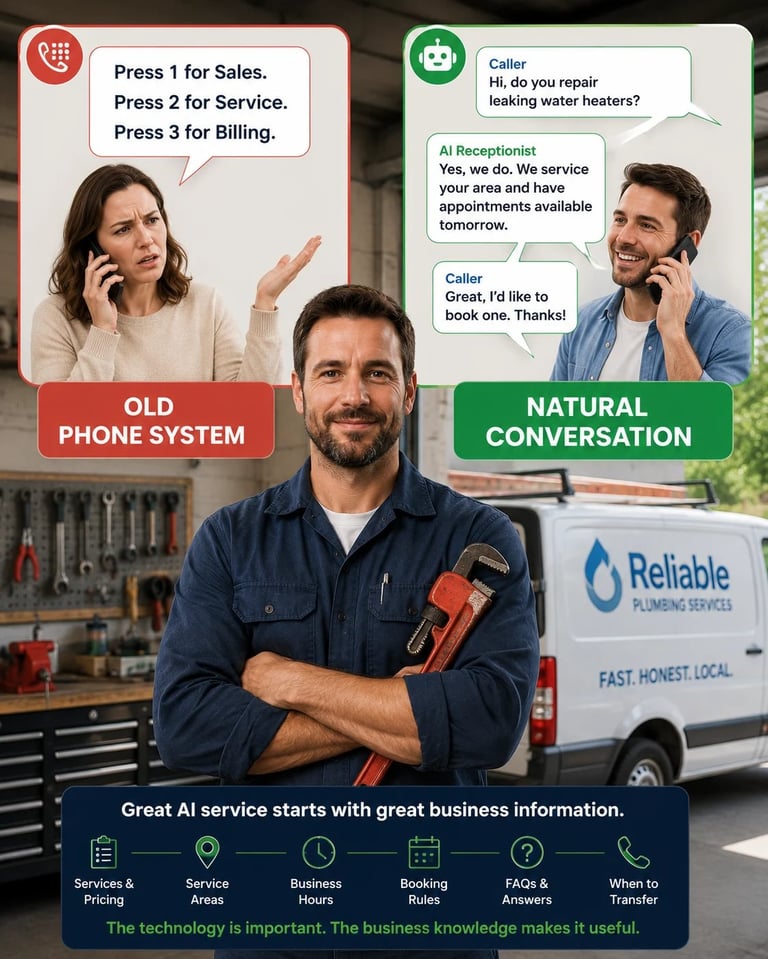
A properly configured AI receptionist works differently. It can communicate conversationally, understand common questions, and respond using information provided by the business.
The quality of the experience depends on the setup. The AI needs accurate information about:
The technology is important, but the business knowledge behind it is what makes the system useful.
An AI receptionist should be viewed as support for the people already working in the business.
It handles repetitive calls so owners and staff can focus on work requiring experience, judgment, and personal attention.
The AI can answer questions about hours, services, pricing, availability, and appointments. Staff can focus on complex enquiries, estimates, customer concerns, and relationship-building.
The AI handles the predictable part of the conversation. People remain responsible for the work that benefits from human knowledge.
Frequent phone calls can disrupt both productivity and customer service. A contractor, consultant, technician, or other service professional may be working directly with a paying customer when another call arrives. Answering interrupts the current job; ignoring it may lose the next one.
An AI receptionist helps separate those two situations. If a call is missed, the system can instantly send a conversational text to keep the lead warm, ensuring the new caller still receives an immediate response.
The owner can then review qualified leads, bookings, and messages at an appropriate time instead of reacting to every incoming call.
The exact results depend on the business and how the system is configured. However, the main benefits are practical:
The value is not simply that the phone gets answered.
The real value is that each caller is moved toward the right next step, whether that means receiving an answer, booking an appointment, providing information, or speaking with a person.
An AI receptionist may be a good fit when your business:
It may be less useful when call volume is very low or nearly every conversation requires immediate professional judgment.
The purpose is not to automate for the sake of automation. It is to solve a real problem in the customer journey.
Begin by reviewing the calls your business already receives. Identify the most common questions, the calls that are frequently missed, the details normally collected, and the appointments that can be booked automatically. Also decide which situations should always be handled by a person.
Start with repetitive and predictable calls. Once those are working well, the system can be expanded carefully.
To simplify this process, book a strategy session or a live demo so we can map out these exact automated workflows for you, keeping your business available when you are busy with the work already in front of you.
About the Author
Christopher Pike is the founder of Booked AI Systems. He partners with local service businesses to build smarter websites, strengthen their SEO and AI visibility, and implement practical automation that captures leads, answers customers faster, and supports steady growth. When he's not helping business owners work smarter, he's testing the latest AI tools to find what actually delivers results — so his clients don't have to.
Our AI handles calls, answers questions, qualifies leads, and books appointments into your calendar — 24/7.